A web-based interactive scenario builder and visualization application for the rfasst air pollution model, an R version of the air quality reduced-form model TM5-FASST.
Using rfasstui
Just getting started with rfasstui? We have constructed a tutorial to examine some sample use-cases which are available here: Tutorial
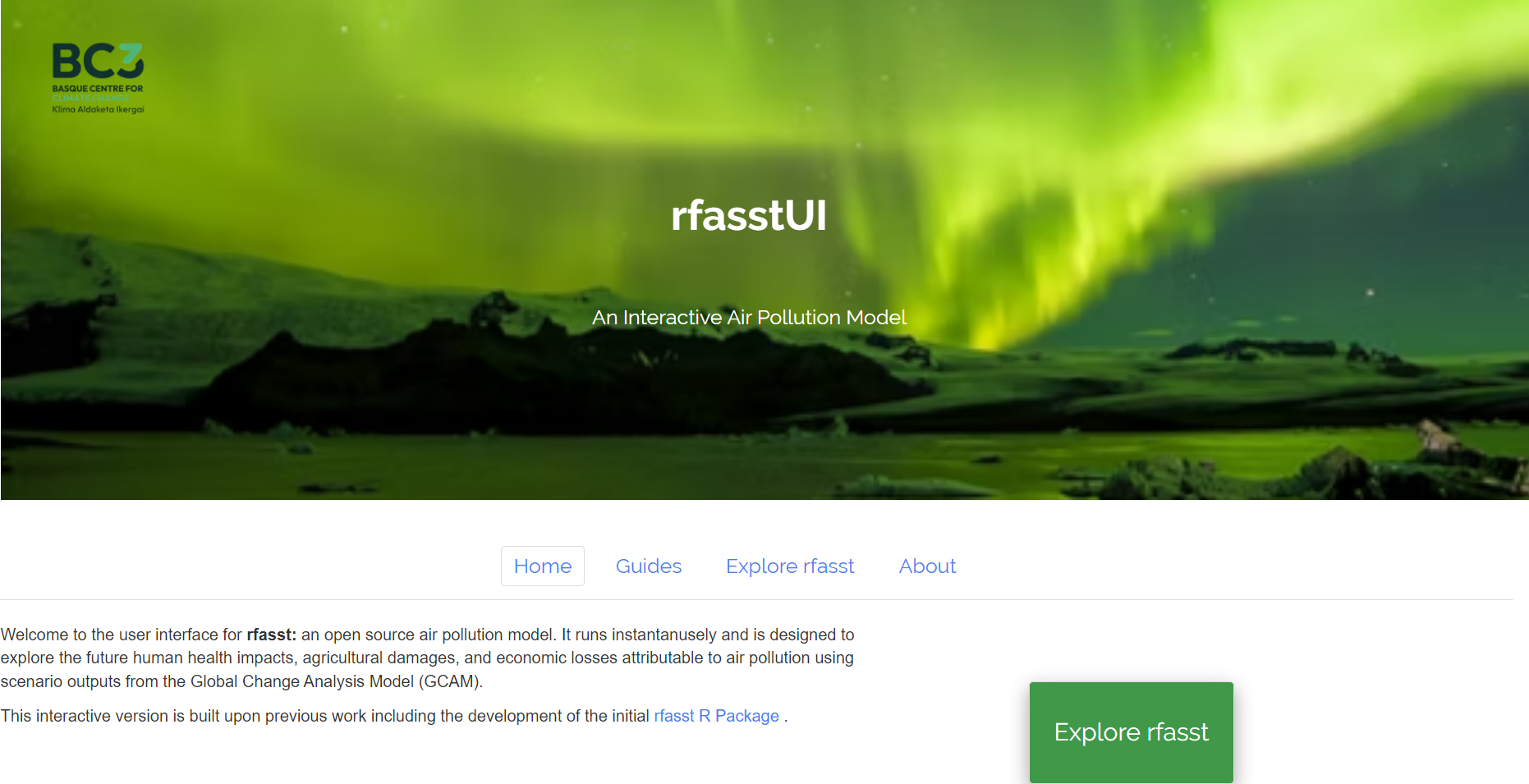
To navigate directly to the rfasstui app CLICK the following image:
Installing Locally
To install rfasstui as an R package for local use, please follow these steps in your R command line:
library(devtools)
devtools::install_github("bc3LC/rfasstui")
Developing Locally
How you launch the app after installation depends on your R environment. See the following.
For RStudio Users
If you are using RStudio, simply open the server.r or ui.r file and execute Run App.
For CMD Users
Start R.exe and enter the following command:
shiny::runApp(system.file("shinyApp", package = "rfasstui"))Contributing to rfasstui
We welcome contributions to rfasstui from the development community. Join in on the conversation at the rfasstui GitHub Discussions page or contact us if you want to collaborate!
For more information about contributing, please contact Clàudia Rodés-Bachs at claudia.rodes@bc3research.org or Jon Sampedro at jon.sampedro@bc3research.org
Learn More About rfasst
Read more about the rfasst air pollution model here: rfasst Documentation, detailed in Sampedro et al. 2022. It is an R version of the TM5-FASST model, detailed in Van Dingenen et al. 2018
Sampedro et al., (2022). “rfasst: An R tool to estimate air pollution impacts on health and agriculture.” Journal of Open Source Software, 7(69), 3820, https://doi.org/10.21105/joss.03820
Van Dingenen, Rita, et al., (2018). “TM5-FASST: a global atmospheric source–receptor model for rapid impact analysis of emission changes on air quality and short-lived climate pollutants.” Atmospheric Chemistry and Physics 18.21: 16173-16211.






